How to DM: Mastering the Art of Storytelling and Combat
So, you’ve decided to pick up the gauntlet. You are ready to sit behind the shield. You want to know how to DM an RPG game!
Whether you are a nervous game master preparing for your first night or a seasoned veteran looking to sharpen your blade, the journey of a Dungeon Master is unlike any other in gaming. You are the narrator, the architect of dreams, the referee, and the biggest fan of your players. At least I hope so.
But let’s be honest: How to DM can feel terrifying. The rules are dense, the players are unpredictable, and the pressure to be the next Matt Mercer or Brennan Lee Mulligan looms large.
Here at Loot Studios, we believe that while beautiful miniatures make the game look incredible, it is your preparation that makes the game feel alive. We aren’t just here to sell you STL files; we are here to help you build worlds.
In this guide, we will cover everything from how to be a Dungeon Master for the first time to handling the chaos when your party inevitably burns down the tavern you spent hours designing.
Let’s turn that anxiety into an epic adventure.
Part 1: The Psychology of the Screen (Mindset First)
I don’t want to sound like a Life Coach, but before we talk about dice, maps, or monsters, we need to talk about you, my friend. The Dungeon Master role is often misunderstood as the “enemy” of the players. And nothing could be further from the truth.
You are not God; you are the Weather
A common trap for new DMs is the “God complex.” You build a world, you write a novel, and you expect the players to walk through it like tourists following a brochure. Then, they don’t. They go left instead of right. They befriend the villain, or they try to open a bakery in the middle of a warzone (real example).
Learning how to be a GM means learning that your job isn’t to control the wind—it is to react to the sails.
The “Yes, And…” Mentality
If you take one piece of advice from this guide, let it be this: Improv is your best friend. When a player asks if there is a guard to seduce, don’t check your notes for “aromantic guards.” Say “Yes, and…” (or “No, but…” if necessary).
How to be a good GM storyteller relies entirely on your ability to make your players feel like their choices matter. If you railroad them (forcing them down a specific path), you kill the magic.
Part 2: The First Session – Building the Foundation
So, you have the courage. Now, where do you start? Preparing your first D&D session as a DM is the biggest hurdle.
The Power of Session Zero
Do not, under any circumstances, skip this. A Session Zero is where you build characters together, set boundaries, and establish the “social contract.”
During this session, you should:
- Set the Tone: Is this a grim horror campaign or a lighthearted comedy?
- Establish Rules: Is PvP allowed? How do we handle absences?
- The “Lines and Veils” Tool: What topics are off-limits (Lines) and what happens “off-screen” (Veils)?
This is also the time to talk about how to introduce players to a D&D campaign. Don’t just have them wake up in a jail cell (unless that fits the plot, of course). Tie their backstories to the main quest.
The One-Hour Rule
How long should a first D&D session be?
Contrary to popular belief, it doesn’t need to be an 8-hour marathon. For new players and new DMs, aim for 2 to 3 hours. The 2024 Dungeon Master’s Guide suggests that for every hour of gameplay, you can accomplish roughly three “things” (a combat, a social scene, or an exploration). Prep for 3 hours, and you have a perfect, tight session.
What Do You Need to Start DMing D&D?
Surprisingly little. You need the Player’s Handbook, a Dungeon Master’s Guide, some dice, and imagination.
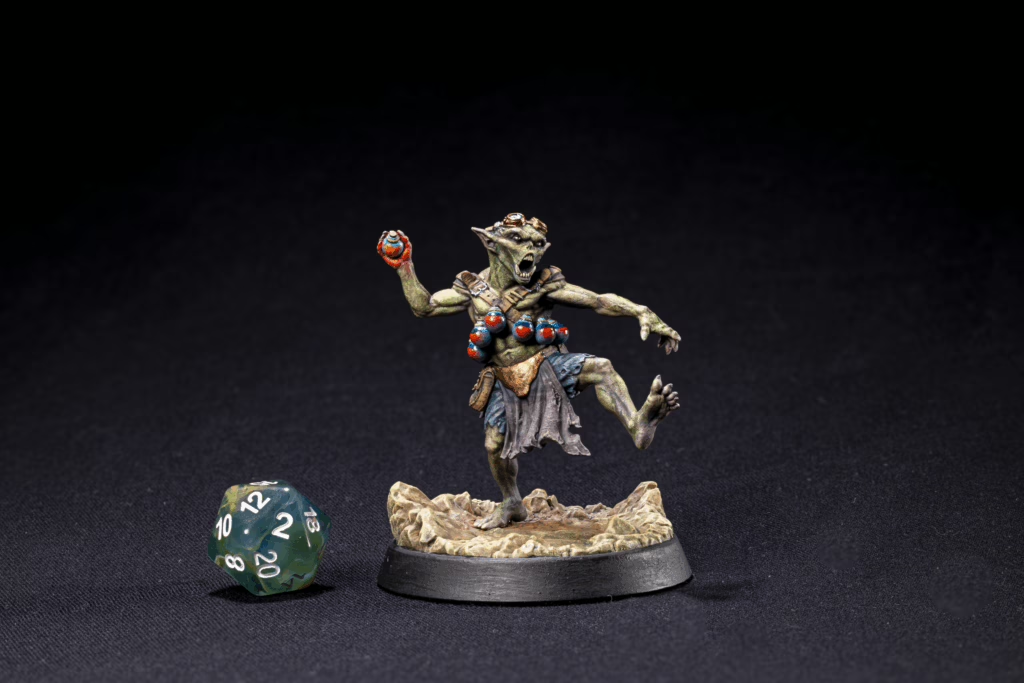
However, to elevate the experience, you need visuals. Don’t get me wrong, I love theater of the mind, but 3D printable miniatures bridge the gap between imagination and reality. When players see a physical goblin on the table, their threat assessment changes. They stop zoning out and start strategizing. To see how physical assets change the flow of a game, check out our guide on Useful 3D-Printed Miniatures to Enhance Your RPG Campaigns.

Part 3: The Art of the Unpredictable (When Players Go Off-Script)
You planned a heist. The players decided to negotiate. You planned a negotiation. The players set the building on fire. A-mazing.
The Illusion of Choice
Like what you do with a toddler on things they still don’t have agency on: “Do you prefer to have carrots or broccoli for lunch?” You give them the illusion of agency and choice, but they are eating their vegetables.
And your players will never know what you didn’t prepare. Say you spent 4 hours building a castle for the final boss, but the players decided to sail to the pirate islands instead. No worries. Move the castle. Rename the king to “Admiral.” The castle is now a pirate fortress.
You aren’t lying; you are dynamically repositioning assets.
The Squeaky Goblin Problem
Sometimes, derailment comes from the players latching onto the most insignificant detail. As discussed by expert GMs, the “Squeaky Goblin” (a random NPC the DM invented on the spot) can become the party’s best friend for 3 years.
Solution: Embrace it. If they love the random goblin, that goblin now has a secret. He is the lost prince of the realm. You just turned a mistake into a plot hook.
How to manage players as a Dungeon Master isn’t about controlling them; it is about channeling their chaos into the narrative. Beautiful, right?
Part 4: Immersion – Painting the Picture
Anyone can say, “You see a dragon.” But a Dungeon Master says, “The air grows hot and smells of sulfur. The clinking of scales echoes off the cavern walls as a pair of golden, slit-pupiled eyes open in the darkness.”
How to describe scenes as a Dungeon Master is about engaging the five senses.
- Sight: What do they see first?
- Sound: Is it silent? Is there dripping water?
- Smell: Rot? Perfume? Ozone?
- Touch: Is the floor sticky? Is the wind sharp?
Terrain for Depth
Description handles the mind, but miniatures handle the physics. And physically, the best tool you have now is a 3D-printed terrain.
When you place a 3D printable terrain piece on the table, players automatically understand cover, elevation, and distance. They stop asking “Can I reach him?” and start asking “Can I push him off that cliff?”
Part 5: Roleplaying NPCs – Finding the Voices
You do not need to be a voice actor. Seriously. Stop worrying about it.
How to roleplay NPCs as a DM is about attitude, not accents.
The Three Pillars of NPCs
- The Body Language: Is the shopkeeper rubbing his hands greedily? Is the guard slouching out of boredom?
- The Objective: What does the NPC want from the party? (Money, help, to get them to leave)?
- The Quirk: Pick one thing. A lisp. A habit of sniffing. A hatred of elves. Just one. Don’t overdo it.
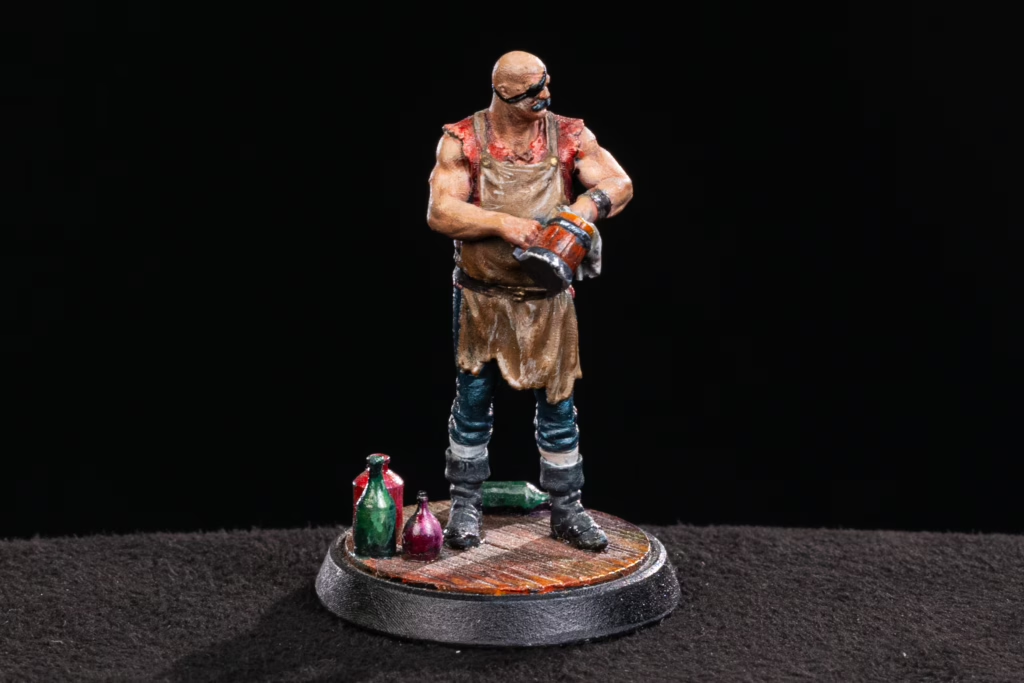
If you want to add physical depth to these NPCs, having a unique miniature for your recurring villain or beloved quest giver changes the dynamic instantly. When that specific miniature hits the table, the players know business is about to go down.
Part 6: Game Systems and Mechanics
While narrative is king, mechanics are the castle walls. Choosing Your TTRPG Dice Systems can drastically alter the feel of your game.
- D&D 5e/5.5e (2024): The standard. High fantasy, heroic power scaling. The new 2024 rules emphasize that encounters should either move players toward a goal, frustrate their progress, or reveal new information.
- Pathfinder 2e: Tactical depth. Every +1 matters. Great for players who love spreadsheets and critical hits.
- OSR (Old School Revival): High lethality. Low power. The goal is to avoid combat, not seek it.
As a DM, you don’t need to master all of them. You just need to pick the one that fits the story you want to tell. To help you decide which vibe fits your table, read our breakdown on Choosing Your TTRPG Dice Systems.
Part 7: Managing the Table (The Social Part)
How to manage players as a Dungeon Master is often 80% of the job.
The Spotlight Rotation
Some players are loud. Some are quiet. It is your job to rotate the spotlight.
- “Grog just smashed the door down. What are you doing, Legolas?”
- “While the rogue is picking the lock, Cleric, you sense a divine presence watching you.”
The Rules Lawyer
You will encounter the player who knows the rulebook better than you. They will correct you.
Listen. If they are right, thank them. If they are wrong or if the rule interrupts the flow, say, “Thanks for the note, Bob. We are going to run it my way for now to keep the pace up, and we will look up the official rule after the session.”
You are the game master. Your word is final, but your ego should not be involved.
Personal example
In my Pathfinder table, we were all noobies once. And, in order to learn the rules, our DM came up with a quite fun dynamic: if one player corrected him or other players about a rule that favored us players, they got a Hero Point. If a player corrected him or other players about a rule that hindered us, two Hero Points.
Now he deeply regrets the consequences of his actions, but it was a nice encouragement in the beginning to detach ourselves from D&D.
Part 8: Tools of the Trade (Upgrading Your Setup)
You have the skills. Now, let’s talk about the gear.
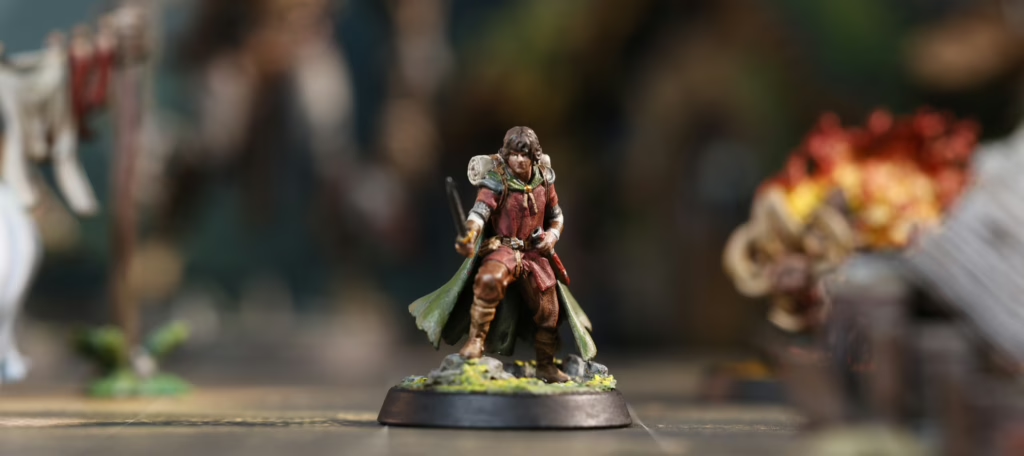
Moving from paper maps to physical assets is a rite of passage. If you are looking to Upgrade Your D&D Setup: From Digital Maps to 3D Printable Miniatures, you are moving from “playing a game” to “curating an experience.”
Specific Tools for DMs
- Props: Print a magical item and hand it to the player physically. We have a Guide of Magical Items that pairs perfectly with physical tokens.
- Herbalism: If your druid loves gathering ingredients, use the Guide to Herbalism and print little mushroom and herb props to hand out. It makes foraging fun.
- Wild Magic: For Sorcerers, nothing says “chaos” like rolling on the Wild Magic table. Add a visual effect by swapping the mini for a “surge” token when it triggers.

Part 9: Longevity – How to Build a Campaign
You have survived Session 1. Now, how do you get to Session 100?
Start Small
Do not build the whole planet. Build a village. In that village, there is a problem (Goblins in the well, let’s say). That problem leads to a clue about a Necromancer in the ruins. That Necromancer works for a Lich. Oh, look! You just accidentally built a campaign.
The Art of the Recap
Start every session with a recap. Ask a player to summarize last week. This does two things:
- It reminds everyone where they are.
- It tells you what they thought was important. If they recap the random bar fight but forget the main quest, maybe the bar fight was the main quest. It happens.
Taking a Break
If you feel burned out, take a break. Play a board game. Read a book. Go outside. Let someone else run a one-shot. A burnt-out DM runs a bad game. A rested DM runs a legend.
Part 10: Call to Action – Bring Your World to Life
We have discussed how to be a Dungeon Master for the first time, how to describe scenes, how to manage players, and how to roleplay NPCs. We have given you the philosophy, the mechanics, and the mindset.
Now it’s your turn. Your journey behind the DM shield starts now. Don’t just tell a story. Live it.
Happy GMing, and may your rolls ever be natural 20s.
Loot Studios can help you tell your story through highly detailed minis, statues, terrains, busts, and props. Sign up for Loot and choose your favorite bundles from our library of more than 130 options. You can also learn more about our printing and painting process by checking our YouTube Channel.

Luiza Romagnoli is an autistic Brazilian woman, journalist, and obsessed with RPG. She has been writing since she can remember, but it was in 2017, posting texts on Instagram, that she began to take it seriously. She has a poetry book published by Patuá Publishing House: sirva o chá. Nowadays, Luiza is a multi-hyphenned professional: she’s a writer, translator, English and Spanish Teacher, and has an RPG stationery store: Papelaria do Aurel. Although having all these jobs almost leave no room for her D&D sessions, she still loves them.