Pathfinder 2e: The Tactical TTRPG That’s Redefining Adventure
So, you’ve mastered the basics of rolling a d20, or perhaps you are just looking for a system where every choice matters. While Dungeons & Dragons dominates the mainstream, a growing chorus of veteran gamers, and some curious newcomers, are asking the same question:
What is Pathfinder? Specifically, the Pathfinder 2e (Second Edition) phenomenon.
If you have spent any time on TTRPG forums lately, you have seen the debate:
“Is Pathfinder D&D with a different coat of paint, or is it an entirely different beast?“
The short answer is that while they share distant DNA, Pathfinder 2e has evolved into something uniquely tactical, incredibly balanced, and deeply rewarding for players who love customization. If you’re a DM tired of trying to “fix” 5e with house rules or a Player who wants a unique character that isn’t just a carbon copy of every other Bard, you are in the right place.
Welcome to your ultimate guide on the Pathfinder system, its history, its brutalist beauty of math, and—most importantly—how to play Pathfinder 2e without needing a college degree in game design.
The History: From Orphaned Child to Genre Giant
To understand Pathfinder 2e, you have to understand the “D&D Divorce” of 2008. Back in the early 2000s, Dungeons & Dragons 3.5 was king. It was complex, crunchy, and beloved. When Wizards of the Coast announced D&D 4th Edition, they also changed their licensing terms, effectively shutting out third-party publishers like Paizo.
Paizo had been publishing Dragon and Dungeon magazines (yes, that’s right name…) for D&D. Suddenly, they had the writers and the fanbase, but no game. So, they did the unthinkable: they took the Open Game License of D&D 3.5 and built their own system: the Pathfinder RPG (1st Edition).
For a while, Pathfinder became the king of the hill. In fact, there was a period where Pathfinder outsold D&D in hobby stores. However, as D&D 5e simplified things, Pathfinder 1e became notorious for “mathfinder”—a bloat of floating modifiers and rulebooks.
Enter Pathfinder 2e (released in 2019). Paizo didn’t merely fix the old system; they completely overhauled it and rebuilt it from scratch. They kept the depth but streamlined the math. They introduced the “Three-Action Economy,” a mechanic so good that players of other systems are begging for it. In 2023, after the OGL crisis, Paizo launched the Remastered Project, replacing the Open Game License with their own Open RPG Creative license, guaranteeing the longevity of Pathfinder 2e, unencumbered by the legal issues faced by their competitor.
And now we have two different RPG systems with both their fans and haters. But this Minstrel who speaks to thee likes and plays both. So let’s take a little trip to the “how Pathfinder works” lane.
The Core Gameplay: The Three-Action Revolution
If you come from D&D 5e—like I have—forget the “Action, Bonus Action, Move, and Interaction” dance. Pathfinder 2e gives you three actions and one reaction on your turn.
That’s it. No, really.
- Stride (Move) is one action.
- Strike (Attack) is one action.
- Raise a Shield is one action.
- Cast a Spell usually costs two actions.
- Opening a Door is one action. (We know it’s not. This is the player’s foulest enemy.)
This Pathfinder action system, explained simply, means tactical freedom. Do you use your third action to step away (avoiding an attack) or to intimidate the goblin? Every single point in combat feels like a chess move.
The “Degrees of Success”
Another massive shift is the four degrees of success: Critical Failure, Failure, Success, and Critical Success.
In D&D, a natural 20 is always a crit.
In Pathfinder 2e, if you beat the DC (Difficulty Class) by 10 or more, you crit. But not always. 10+ improves your roll, and 10- worsens your roll.
Sometimes, an outcome of 10 or more turns a failure into a success or, in the worst-case scenario, turns a critical failure into a failure.
And if you fail by 10 or more, you critically fail. This makes every +1 bonus mathematically significant.
How a Turn Works: Real Play Examples
Let’s put you at the table. You are Kaelen, a level 2 Human Fighter. With you, there is a longsword, a steel shield, and a bad attitude. You are facing a Hobgoblin Archer (30 feet away) and a Goblin War Chanter (right in your face).
Example 1: The D&D 5e Turn (For Context)
In D&D 5e, your turn might look like this:
- Action: Attack the Goblin. (One swing).
- Bonus Action: Maybe use Second Wind to heal.
- Move: Walk 30 feet toward the Archer.
- End of turn. You feel like you did “enough.”
Example 2: The Pathfinder 2e Turn (The Depth)
Now, in the Pathfinder system, you have Three Actions. Watch how different this feels:
1st Option: The Aggressor (All-out attack)
- Action 1: Strike the Goblin War Chanter in front of you. (Roll d20 + 9). You hit!
- Action 2: Strike the same goblin again. This second attack has a Multiple Attack Penalty (MAP) of -5. You roll again. You miss.
- Action 3: Strike a third time! MAP is now -10. You roll a natural 20. Because you beat the AC by 10, it’s a critical hit! You kill the goblin.
- Reaction (Ready): If the Hobgoblin shoots an arrow at you, you can use your Shield Block reaction to reduce the damage or deny the attack if the Shield Bonus is high enough.
2nd Option: The Tactician (Setting up the team)
- Action 1: Raise Shield. (+2 to your Armor Class until your next turn).
- Action 2: Stride (Move) 25 feet toward the Hobgoblin Archer.
- Action 3: Demoralize. You roll Intimidation vs. the Hobgoblin’s Will DC. You succeed! The Hobgoblin is now Frightened 1 (-1 to all its checks and DCs for one round). This helps your Wizard land a spell next.
- Result: You are safer, closer, and you debuffed the enemy.
3rd Option: The Desperate Escape
- Action 1: Step (5-foot move that doesn’t trigger reactions). You back away from the Goblin.
- Action 2: Interact (Draw a potion from your belt).
- Action 3: Drink the Potion (Heal 1d8 HP).
- Result: You live to fight another round.
Example 3: The Spellcaster Turn
You are a Sorcerer. You want to cast Fireball. Classic in all systems.
- Action 1: Cast a Spell (Fireball costs 2 actions). You point at the center of the room.
- Action 2: (Included in the 2-action spell cast).
- Action 3: Stride (Move behind the pillar for cover).
- Note: If you want to cast Shield (a cantrip), that costs 1 action. You could cast Shield and Fireball in the same turn, but you couldn’t move.
Example 4: The “Oops” Moment
You decide to run past a goblin to save your friend.
- Action 1: Stride (move into the goblin’s reach). This triggers a Reaction from the goblin: Reactive Strike (aka Attack of Opportunity—most goblins have it!). The goblin hits you.
- Action 2: Stride again (trying to leave the goblin’s reach). This triggers another Attack of Opportunity. You get hit again and fall unconscious.
- Lesson learned: In Pathfinder 2e, movement is precious. You don’t run past enemies unless you have a plan (like using the Tumble Through Acrobatics action).
Pathfinder 2e vs D&D 5e: The Detailed Breakdown
This is the Pathfinder vs. Dungeons and Dragons 5e debate that fuels the internet. Which is better? It depends entirely on what you want. Let’s go beyond the surface-level differences:
1. Character Customization
- D&D 5e: You choose a race, subrace, class, and subclass (usually at level 3). After level 3, most choices are just which spell to pick or whether to take an Ability Score Improvement or a Feat.
- Pathfinder 2e: You get a meaningful choice every single level. Ancestry Feats grant you new powers based on your race, such as Darkvision or climbing speed. Skill Feats (your Athletics lets you jump twice as far; your Medicine lets you treat wounds better). Class Feats (your Fighter learns a special stance or a spinning attack). This makes the Pathfinder system a dream for Advanced Players.
2. The Three-Action Economy vs Action/Bonus Action
- D&D 5e: “Can I use my Bonus Action to off-hand attack? Wait, I already used my Move. Can I convert my Action into a Bonus Action? No.”
- Pathfinder 2e: “I have three actions. I use one to move, one to attack, and one to raise my shield.” It is intuitive. There is no confusion about what is a “bonus action” versus an “interaction.”
3. Critical Hits
- D&D 5e: Roll a natural 20. Double the dice. Amazing.
- Pathfinder 2e: Beat the Armor Class by 10. You crit. A mighty warrior attacking a goblin (AC 16) with a +14 to hit? He crits on a roll of 12 or higher (because 12+14=26, which is 10 over 16). You feel powerful. A dragon attacking you? It will crit you constantly if you don’t buff your AC.
4. Healing and Resting (The “Wounded” System)
- D&D 5e: You wake up from a Long Rest with all HP restored. Short rests are for Hit Dice.
- Pathfinder 2e: Medicine matters. You use the Treat Wounds action (takes 10 minutes) to heal. You can do this between fights. However, if you go down to 0 HP, you gain the Wounded condition. If you go down again, you start closer to death. You cannot simply “yo-yo” heal like in 5e. This makes combat scarier and healing more strategic. (I’ve died twice with this little play here.)
5. Death and Dying
- D&D 5e: You make Death Saving Throws. Three failures = death. Three successes = stable at 1 HP.
- Pathfinder 2e: You have a Dying value (Dying 1, Dying 2, etc.). If you take damage while dying, your Dying value increases. If it reaches 4, you die. Also, when you are revived, you gain Wounded 1. Next time you go down, you start at Dying 2. This prevents the “whack-a-mole” healing cheese.
6. Exploration Mode
- D&D 5e: Exploration is usually loose. “I search the room.” Roll Perception.
- Pathfinder 2e: You choose an Exploration Activity. Scout (give the party a +1 to initiative). Search (you are actively looking for traps). Defend (you keep your shield raised). Avoid Notice (you are sneaking). You choose one activity that represents what you do while walking through the dungeon. This keeps the game moving without “I roll Perception every 5 feet.”
7. Magic Items
- D&D 5e: Magic items are optional and unbalancing.
- Pathfinder 2e: Magic items are required for math balance. You will get Fundamental Runes (+1 weapons, +1 armor). Handing out a Flaming Longsword is part of the expected progression. It feels epic, and because of the tight math, it works perfectly.
Pros and Cons: Is This System for You?
Before we dive into how to play Pathfinder 2e step by step, let’s look at the good and the bad.
The Pros
- The Three-Action Economy: Fluid, intuitive, and tactical. It feels like a modern TTRPG should.
- Incredible Character Diversity: You will never play the same character twice.
- Awesome Martials: Fighters and Barbarians get cool “feats” that let them do whirlwind attacks or jump across chasms. No more “I hit it with my stick” every turn.
- It’s Free (Legally): Paizo publishes all rules online via the Archives of Nethys (2e.aonprd.com). You don’t need to buy the books to start playing.
- GM Support: The encounter math works. Severe difficulty means severe. You won’t accidentally TPK your party with a “medium” encounter like in 5e.
The Cons
- The “Crunch”: There are conditions. So many conditions. Frightened, Sickened, Clumsy, Stupefied, Enfeebled, Drained… you might need the RPG Miniatures Guide just to keep track of who has what. Just saying.
- Character Complexity: If you suffer from analysis paralysis, the sheer volume of feats might overwhelm you. It is best for Players who love reading options.
- Tactical Rigidity: You need to play tactically. You can’t just “run in and attack” like in 5e; you will die. You need to flank, debuff, and buff.
How to Play Pathfinder 2e (The Quickstart Guide)
Ready to roll initiative? Here is your Pathfinder 2e beginner guide on getting started.
Step 1: Get the Rules (For Free!)
Go to the Archives of Nethys. Seriously. It has every rule, monster, and item. If you prefer video, check out the How to Play Pathfinder 2e series by Rules Lawyer or How It’s Played on YouTube. They break down the concepts brilliantly.
Step 2: What Books Do You Need to Play Pathfinder?
Technically, none. But if you want the physical books (or PDFs) for reading, here is the Pathfinder 2e books list:
- Player Core: This is the essential one for players. It contains the core classes, ancestries, and spells for the Remastered rules.
- GM Core: The Dungeon Master’s Guide equivalent.
- Monster Core: The bestiary.
Note: You do NOT need the old “Core Rulebook” (2019). Look for the “Remastered” Player Core.
Step 3: Character Creation (The ABCs)
- Ancestry: Pick your race (Human, Elf, Dwarf, Goblin, etc.). Choose a Heritage (like “Woodland Elf” or “Snow Goblin”). Pick an Ancestry Feat (e.g., “Goblin Song” to distract enemies).
- Background: What did you do before adventuring? (Criminal, Scholar, Farmer). This gives you a Skill Feat (like “Quick Jump” or “Experienced Tracker”).
- Class: Pick your class. This gives you your main combat abilities.
- Key Ability: Boost your main stat (Strength for Fighters, Intelligence for Wizards).
- Four Free Boosts: You get four ability boosts to distribute anywhere (max starting stat is 18).
Step 4: The Beginner’s Setup
If you are a DM beginner, buy the Pathfinder Beginner Box. It is the best intro product in TTRPGs, coming with a solo adventure, a simplified rulebook, and a double-sided flip-mat. It teaches you and your players the three-action system slowly, room by room.
Step 5: Running Your First Combat (The Goblin Fight)
The DM says: “Three goblins rush out of the bushes. Roll Initiative!”
- Initiative: In PF2e, you usually roll Perception for initiative, unless you were sneaking (Stealth) or using a social skill (Diplomacy).
- Round 1, Turn 1 (The Fighter): “I use my first action to Stride up to Goblin A. Second action, I Strike with my sword. I hit! Third action, I Raise my Shield.”
- Round 1, Turn 2 (The Goblin): “The goblin uses one action to Stride behind the Fighter. He uses his second action to Strike the Fighter. Because the Fighter raised his shield, the AC is higher. The goblin misses! He uses his third action to Scamper (a goblin ability to move again).”
- Round 1, Turn 3 (The Wizard): “I use two actions to cast Electric Arc on Goblin A and B. They must make Reflex saves. They fail! They take damage. I use my third action to Step five feet away from the third goblin.”
See the rhythm? Beautiful!
Why Miniatures Matter in Pathfinder
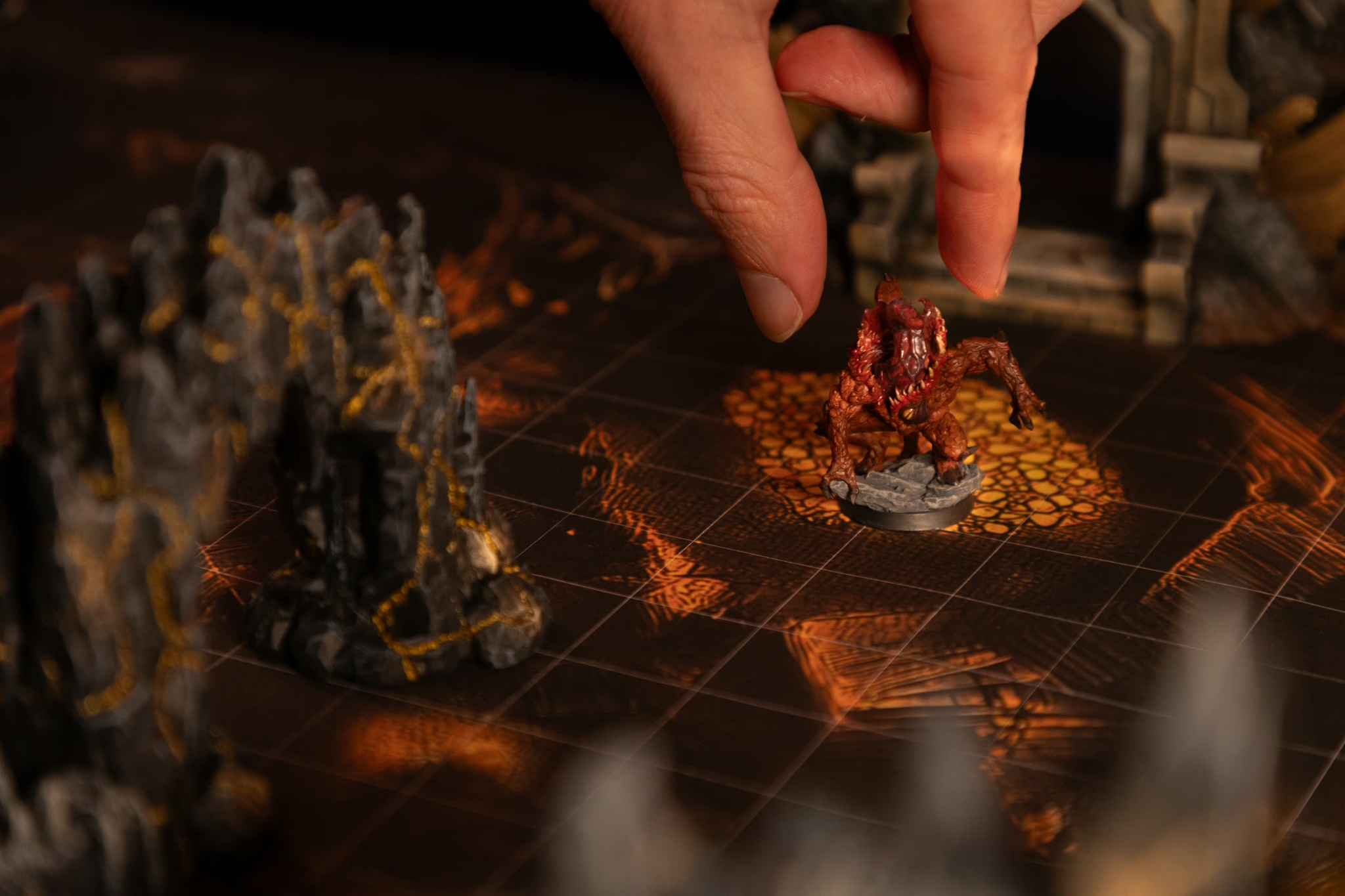
You might have noticed that Pathfinder 2e is tactical. Flanking matters. Cover matters. Area-of-effect spells matter. The difference between 15 feet and 20 feet is the difference between hitting three goblins or hitting your friend.
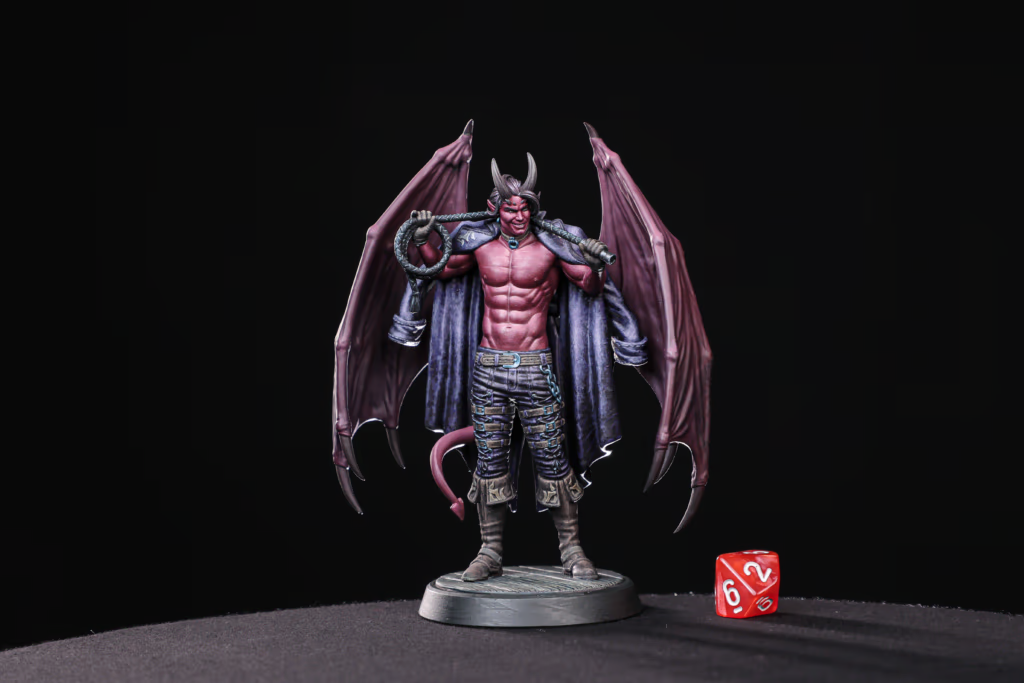
While you can play “theater of the mind,” Pathfinder truly shines with a grid. This is where Loot Studios enters the chat. Because you are facing a Hobgoblin General, a Giant Spider, and a Trap filled with spikes—you need to see the battlefield.
If you are setting up a campaign, you need to check out our guide on How to Upgrade Your D&D Setup. While it says “D&D,” the principles apply perfectly to Pathfinder. You need high-quality, tactile RPG miniatures to track the complex positioning of the Pathfinder system.
In Pathfinder 2e, the tight math means that knowing exactly who is flanking whom is a matter of life and death. Using our pre-supported, detailed STL files allows you to print the exact monster for the encounter. Why use a generic token for the dragon when you can print a terrifying, 3D sculpt?
Furthermore, Pathfinder encourages GMs to use various enemies, such as goblins, hobgoblins, and bugbears, making 3D printing the most cost-effective solution. Instead of buying individual packs, you can decide whether to buy or print miniatures, and spoiler alert: printing is the way to go for the sheer volume PF2e throws at you.
If you are still exploring other systems, check out our guide on the Best Tabletop RPGs to Play with Miniatures to see where Pathfinder ranks. And once you are ready to tell a story, our guide on How to Start Your First RPG Campaign will help you build the world your PF2e heroes will save (or destroy).
Final Thoughts: Is Pathfinder 2e Right for Your Table?
Don’t get me wrong. I love D&D! It’s been with me for a great part of my life, and it’s easy to play, with flaws and all, and I love the possibility of homebrewing rules, classes, and races!
But if you are looking for a game where your choices matter, where the rules support the story without breaking, then take the plunge. Pathfinder 2e respects your intelligence as a gamer. (I am not that smart, though. I keep getting beat up by the game. Well, I still love it).
Is it more work than D&D 5e? Yes. But the payoff is a campaign that can run from levels 1 to 20 without the math breaking down, where a dragon fight feels like a terrifying tactical puzzle.
Ready to start your first campaign?
You have the rules, you have the drive, and now you need the visual spectacle. Don’t let your epic three-action flurry happen on a blank white grid.
Loot Studios can help you tell your story through highly detailed minis, statues, terrains, busts, and props. Sign up for Loot and choose your favorite bundles from our library of more than 130 options. You can also learn more about our printing and painting process by checking our YouTube Channel.

Luiza Romagnoli is an autistic Brazilian woman, journalist, and obsessed with RPG. She has been writing since she can remember, but it was in 2017, posting texts on Instagram, that she began to take it seriously. She has a poetry book published by Patuá Publishing House: sirva o chá. Nowadays, Luiza is a multi-hyphenned professional: she’s a writer, translator, English and Spanish Teacher, and has an RPG stationery store: Papelaria do Aurel. Although having all these jobs almost leave no room for her D&D sessions, she still loves them.