D&D vs. Pathfinder: The Ultimate Showdown for Your Next Epic Campaign
But remember: There’s no right or wrong. Just different.
You’ve seen the dice towers, heard the legendary tales of critical hits, and felt the call to adventure. But before you gather your party, you face a modern dilemma: D&D vs. Pathfinder—which tabletop RPG reigns supreme for your group? In this comprehensive guide, we will dissect the difference between Pathfinder and D&D, exploring their unique histories, core philosophies, and mechanical nuances. By the end, you’ll have a crystal-clear answer to the age-old question: is D&D or Pathfinder better for your table?
What is an RPG System? Understanding the Basics
Before we dive into the clash of titans, let’s take a step back. What is an RPG system? Simply put, it’s the set of rules that governs your collaborative storytelling. Think of it as the engine of a car. The narrative—your epic quest to slay a dragon or rescue a prince—is the body and paint job. But the system is the engine that determines how you accelerate (combat), how you steer (skill checks), and how you handle a flat tire (character death). Choosing the right engine is crucial for a smooth ride. For a broader look at different rule sets, check out our guide on how to choose a great RPG combat system , which explores different mechanical philosophies.
A Brief History of Two Giants
To truly understand the difference between D&D and Pathfinder in the present, we need to look at the past.
Dungeons & Dragons: The Original Game Changer
Born in 1974 from the minds of Gary Gygax and Dave Arneson, D&D didn’t just start a hobby; it created a genre. From the clunky mechanics of Chainmail to the cultural phenomenon of the “Satanic Panic” and the glory days of D&D 3.5e, the game has evolved dramatically. The release of D&D 5e (5th Edition) in 2014 was a watershed moment. Wizards of the Coast streamlined decades of complex rules into an accessible, narrative-first system. Suddenly, everyone from college freshmen to Hollywood celebrities were playing. It became the “gateway drug” for tabletop RPGs, thanks in large part to shows like Critical Role (funny enough, they started Campaign One—The Legend of Vox Machina—playing Pathfinder and changed to D&D mid-campaign.)
Pathfinder: The Successor Born from Dissatisfaction
Pathfinder’s origin story is one of the most fascinating in gaming. When Wizards of the Coast released D&D 4th Edition in 2008, many veteran players felt the system had become too “video game-like” and tactical, losing its narrative soul. Enter Paizo Publishing. They took the open-source rules of D&D 3.5e—widely considered the most robust and complex version—refined them, and released Pathfinder 1st Edition. It was a massive success. For years, Pathfinder outsold D&D, becoming the champion for players who wanted depth, customization, and challenge. In 2019, Paizo released Pathfinder 2e (2nd Edition), a ground-up rebuild that aimed to keep the tactical depth but add modern streamlining.
The Core Philosophical Difference: Simplicity vs. Depth
At the heart of the D&D vs. Pathfinder debate lies a philosophical divide. D&D 5e vs. Pathfinder 2e is essentially a battle between “rulings, not rules” and “rules for everything.”
D&D 5e: The Flexible Story Engine
D&D 5e operates on the principle that the Dungeon Master (DM) should be empowered to make quick decisions. The rules are broad, often ambiguous, and designed to get out of the way of the story. If a player wants to do something weird—like swing on a chandelier while shooting a bow—the DM makes a snap judgment (usually an Ability Check with Advantage/Disadvantage) and moves on. This makes the game incredibly fast and fluid, perfect for groups who love improv and drama.
Pathfinder 2e: The Tactical Playground
Pathfinder 2e asks, “What if every action had a rule?” This sounds intimidating, but it creates a brilliant tactical puzzle. Instead of the “Action/Move/Bonus Action” economy of D&D, Pathfinder gives you three actions per turn. Want to attack three times? Go for it (though penalties apply). Want to move, open a door, and then intimidate an enemy? That’s three actions. This “Three-Action Economy” is widely praised as one of the most elegant combat designs in TTRPG history. It offers clarity and fairness; the players know exactly what they can do, and the Game Master (GM) doesn’t have to invent rulings on the fly.

Detailed Breakdown: Key Differences and Similarities
Let’s get into the nitty-gritty. Here is the difference between Pathfinder and D&D broken down by category.
1. Character Creation
- D&D 5e: Fast and archetypal. You pick a Race (Lineage), Class, and Subclass (usually at level 3). The choices are meaningful but limited. You won’t break the game by picking a “cool” feat over a “powerful” one. It is incredibly hard to build a useless character.
- Pathfinder 2e: Deep and modular. At every level, you are making a choice: a Skill Feat, a Class Feat, a General Feat, or an Ancestry Feat. The customization is staggering. Want to be a Dwarven Wizard who specializes in medicine and two-weapon fighting? Pathfinder 2e has a specific feat chain for that. However, it is easier to make a “bad” choice if you don’t understand the synergy.
2. Combat Tactics
- D&D 5e: Movement is sticky. Usually, once you are next to an enemy, you stand there rolling attacks until someone dies. Flanking is an optional rule but gives an advantage, and every creature has an Opportunity Attack as a reaction. The “Help” action is rarely used.
- Pathfinder 2e: Movement is king. Because taking a third attack is usually a waste (due to the Multiple Attack Penalty), and players are encouraged to move, demoralize, feint, shove, trip, etc. Combat is highly fluid. Flanking matters more, and team tactics are highly recommended—you can’t combo by yourself; you need everyone in the party. And here, movement is easier because you don’t have Opportunity Attack. The players need a feat (Stand Still) to have this ability, and some foes do have it and some don’t. So, yeah, strategy.
3. Magic and Martials (The “Linear Warrior, Quadratic Wizard” Problem)
- D&D 5e: This issue persists. At high levels, Wizards can reshape reality while Fighters just hit harder. Martials rely on the DM to give them magic items to keep up. I don’t know a single D&D DM that wants to lead the campaign to level 20 because “players are too strong and combat is not interesting anymore.” I disagree, but that’s me.
- Pathfinder 2e: Paizo fixed this beautifully. Martials are terrifying and often more impactful in single-target damage than casters. Spells have been tuned down; they offer amazing utility and crowd control, but Fighters and Barbarians are the undisputed kings of dealing damage.
4. The “Swinginess” of the Dice
- D&D 5e: Very swingy. The d20 is king, and because modifiers stay relatively low (rarely exceeding +11), a goblin can theoretically hit a dragon 5% of the time. Which is one of my critics to D&D. It makes no sense, since a dragon is huge; you can’t miss an attack… Like… The goblin should be harder to miss, you know?
- Pathfinder 2e: Tight math. Thanks to “Level to Proficiency,” a high-level monster has an AC so high a low-level character cannot hit it except on a natural 20 (which upgrades the success level). This creates a world where the challenge rating actually works, but it feels less “wild.” Real desperation.
Similarities: The Shared DNA
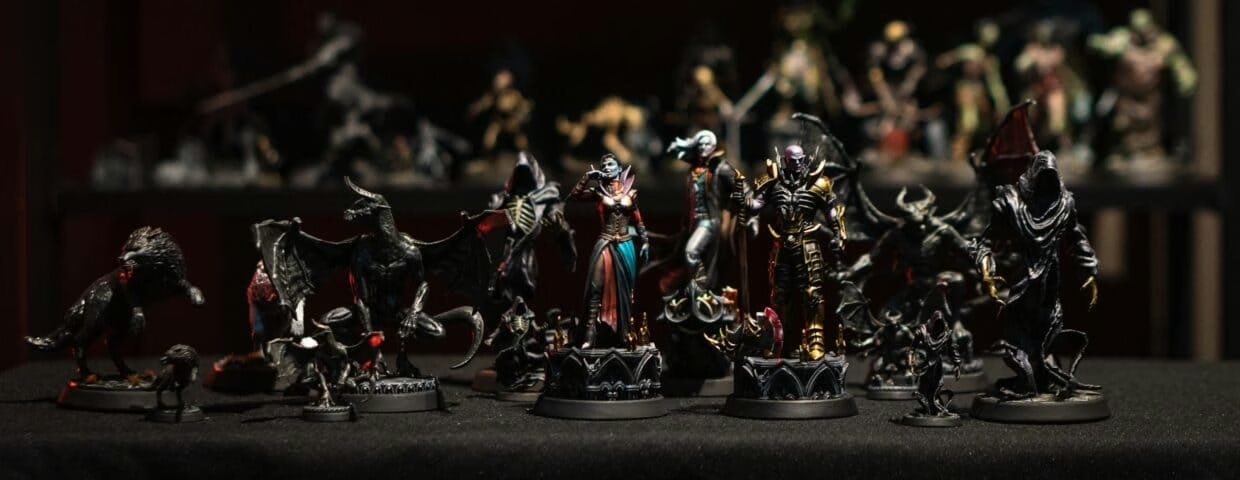
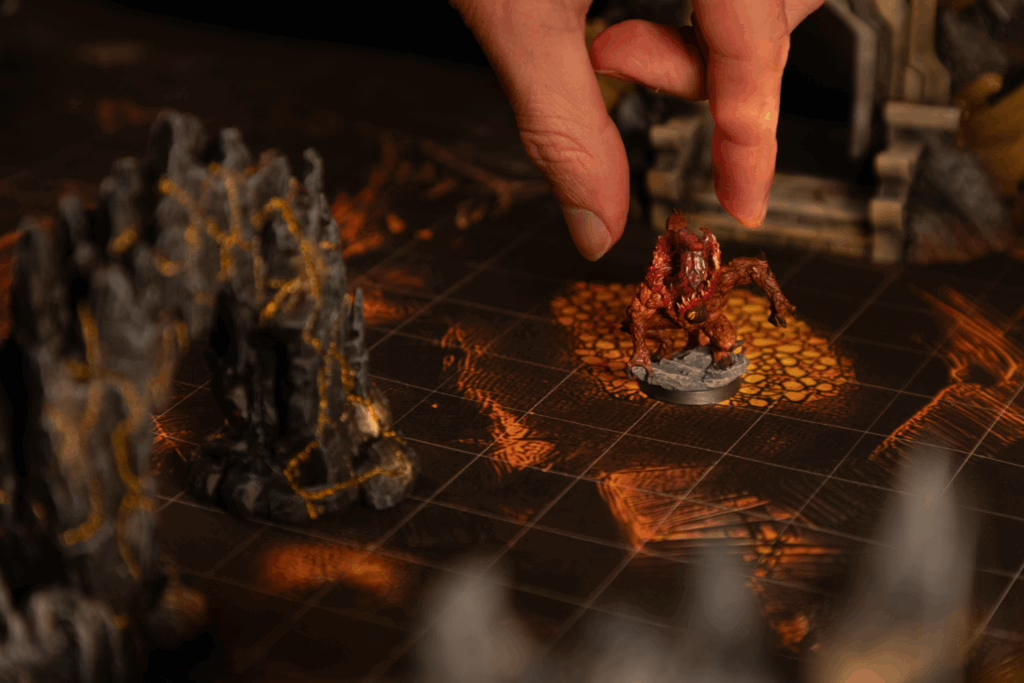
Despite their differences, they are more alike than different. Both are d20 systems (you roll a 20-sided die for most checks). Both feature Fantasy RPG tropes: Elves, Dwarves, Dragons, and Dungeons. Both require a Game Master and a party of players. Both support tactical play with miniatures and grids. And for both, having high-quality 3D printed miniatures from Loot Studios elevates the experience from a game to a legendary saga. *Wink*
Which One Should You Choose? Is D&D or Pathfinder Better for You?
The short answer is “depends.” Let’s look at the long-tail questions you might be asking.
Is D&D easier than Pathfinder for beginners?
Yes. If you are asking how to choose a tabletop RPG system for a group of total beginners, start with D&D 5e. The “Backgrounds” system, the streamlined Advantage/Disadvantage mechanic, and the sheer volume of online resources (like our Beginner’s Guide to DnD) make onboarding easy peasy.
So, Is Pathfinder harder than D&D 5e?
Yes, but “harder” isn’t “worse.” Pathfinder 2e has a steeper learning curve at character creation and control. However, the gameplay at the table is often clearer than D&D because the rules cover every eventuality. There is less arguing with the GM about what is possible. If your group loves video games like Gloomhaven or XCOM, Pathfinder’s tactical depth will feel like home.
Pathfinder 2e also has something that really helps beginners: the Beginners Box. It comes with a small map; character sheets all done so you don’t have to worry about where to start; and cheat sheets to consult rules and what you can do with your three actions. The Beginners Box works as much for players as for new DMs. It’s really helpful.
Should I start with D&D or Pathfinder as a beginner?
It always depends on what you want to play. Here is a simple flowchart for how to start playing tabletop RPGs:
- Start with D&D 5e if: You want to tell a story, create your own rules, your sessions are heavy on roleplay and light on combat.
- Start with Pathfinder 2e if: Your group loves tactical wargames, you hate ambiguity (you want the rulebook to have an answer for everything), you love optimizing builds, or you are moving from D&D 3.5e.
The Veteran Perspective: DM and Player Considerations
For the Game Master (DM/GM)
- D&D 5e: Easy to start, hard to master. The lack of rules means you have to improvise a lot. Balancing high-level encounters is notoriously broken (CR is a lie).
- Pathfinder 2e: Hard to start, easy to run. The encounter building rules work. The “Conditions” are standardized (instead of 50 different spells doing 50 different things, they apply “Slowed,” “Stunned,” or “Frightened”). Paizo’s Adventure Paths are widely considered superior to WotC’s campaigns in terms of writing and logistics.
For the Painter and Collector
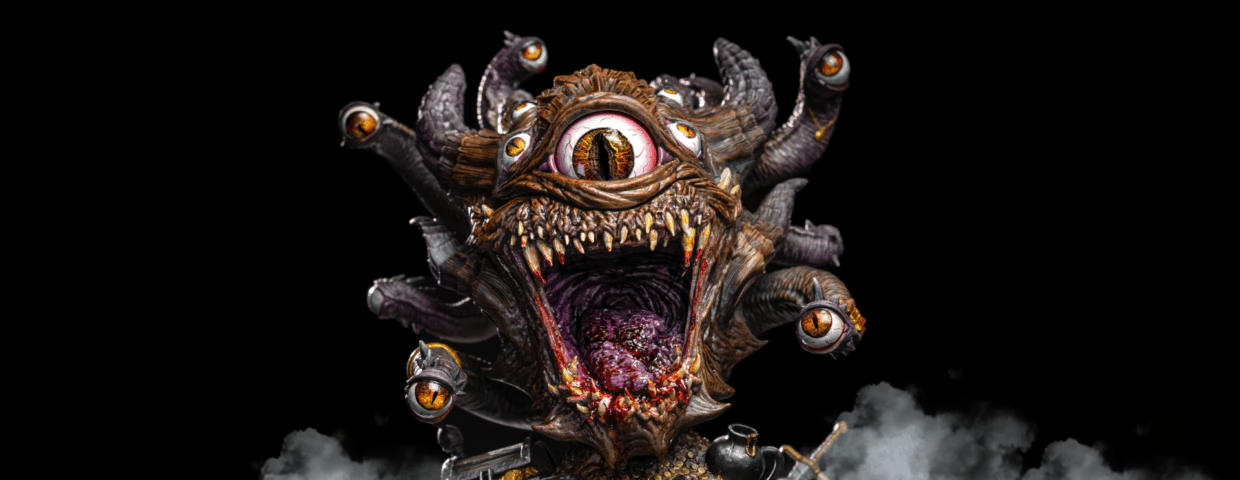
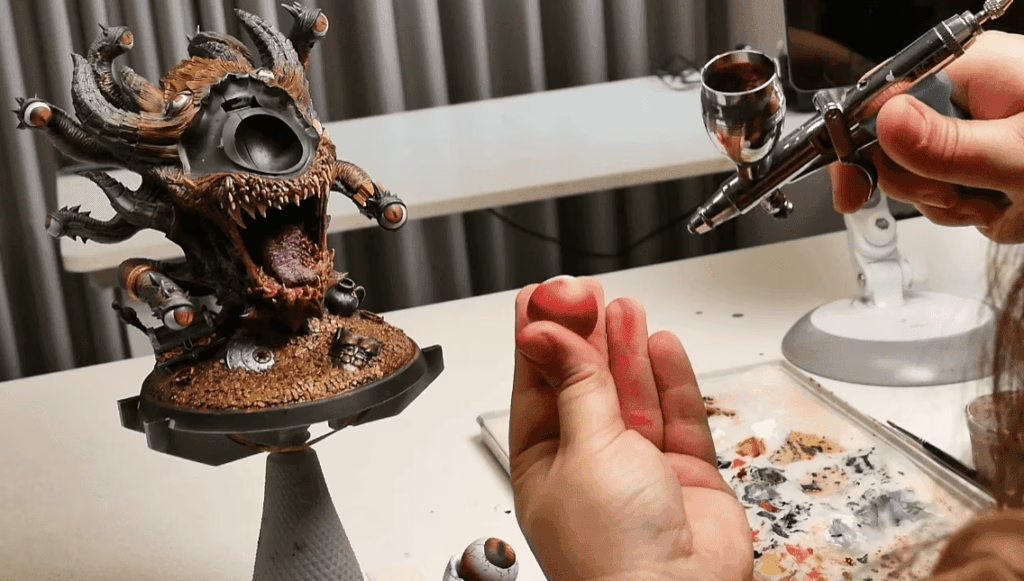
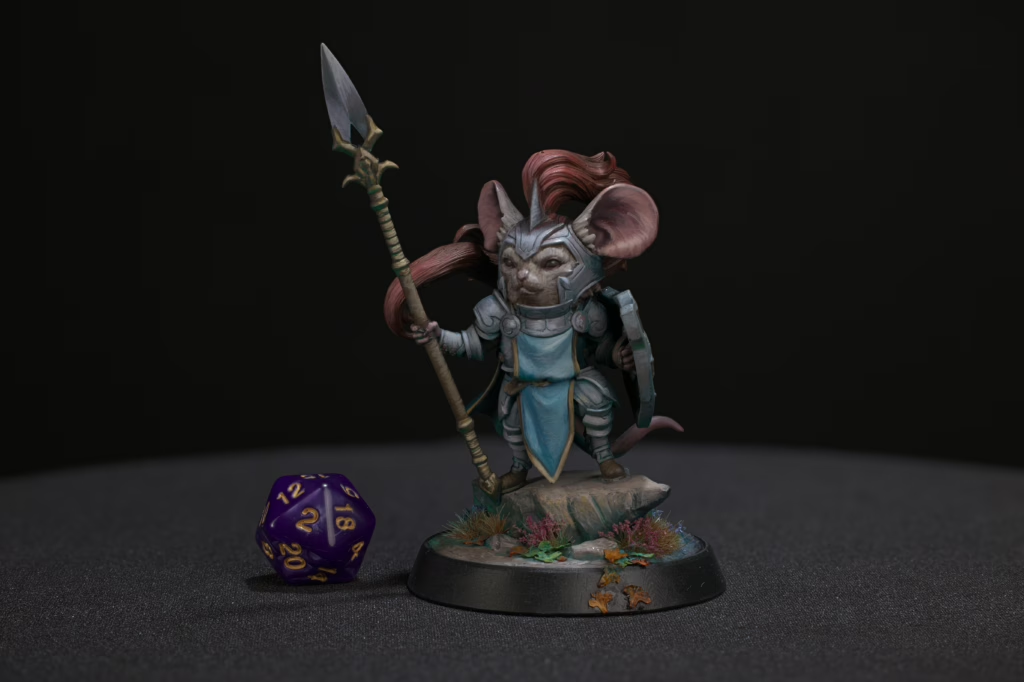
This is where Loot Studios comes in. Regardless of which side of the D&D vs. Pathfinder war you fall on, the miniatures are interchangeable. A Beholder is a Beholder. A Goblin is a Goblin. However, the art style differs.
- D&D tends toward high fantasy, iconic monsters, and whimsical heroes.
- Pathfinder leans into “gritty high fantasy,” with more spikes, belts, and intricate armor designs (think “Final Fantasy meets Dark Souls”).
Because Pathfinder 2e features more specific enemy types (like the unique “Leshy” plant creatures or the clockwork “Automaton” ancestry), collectors might find a slightly wider variety of niche monsters to paint. But for pure volume and quality, we support both systems perfectly. *Wink*
Transitioning Between Systems
I started a D&D girly myself. To the point of memorizing rules, spells, items, everything. One beautiful day, my friends and I decided to try Pathfinder, just for kicks. And it was hard. To disassociate everything I knew about a fantasy RPG and lose some vices like names and mechanics was a challenge. But we were persistent, and now I am obsessed with the character I built.
We never abandoned our dearest D&D. And I had my share of hitting the “Level 12 Wall,” ok? Truth is: it really depends on how you want to play, if it is more focused on roleplay and homebrewing rules, classes, etc., like D&D, or if you are more prone to tactics, tight rules and combat strategy like Pathfinder.
The Verdict: D&D Vs. Pathfinder: Which Should You Play?
Ok. You want a more concrete answer. Let’s settle the debate. D&D vs. Pathfinder: which should you play?
- Play D&D 5e if you want the “Indie Movie” of RPGs: Character-driven, loose, emotional, and focused on the vibes.
- Play Pathfinder 2e if you want the “Christopher Nolan Film” of RPGs: a structured, intellectually satisfying, tactical, and rewarding system mastery.
The D&D vs. Pathfinder rules and gameplay comparison ultimately shows that they serve two different masters. D&D serves the narrative. Pathfinder serves the game.
Ready to Play? How to Start Your First Campaign
Once you have chosen your champion, you need to actually start playing. Whether you pick the streamlined heroism of D&D or the tactical depth of Pathfinder, the first step is the same: gather your party.
For new Game Masters, the anxiety of running a session is real. That is why we created a resource to help you navigate the chaos. Download our free Game Master Guide . It covers everything from building a compelling villain to managing the spotlight at a crowded table. It is system-agnostic, meaning it works for both D&D and Pathfinder.
Building Your First Adventure
Don’t try to build a whole world yet. That is a trap that kills more campaigns than a Tarrasque. Instead, for starters, run a pre-written one-shot.
- For D&D, look for The Lost Mine of Phandelver.
- For Pathfinder, look for The Beginner Box, already mentioned here (which features “Trouble In Otari“).
If you need guidance on structuring the long-term journey, our article on how to start your first RPG campaign is an essential reading.
Conclusion: Your Epic Awaits
The debate over D&D vs. Pathfinder will rage on forums forever, but the truth is there is no “better” system—only the system that is better for you. Both offer endless adventures, camaraderie, and memories that will last a lifetime.
So, which door do you open? The familiar, welcoming tavern of Dungeons & Dragons, or the gritty, tactical war room of Pathfinder?
Your adventure awaits—roll for initiative.
Loot Studios can help you tell your story through highly detailed minis, statues, terrains, busts, and props. Sign up for Loot and choose your favorite bundles from our library of more than 130 options. You can also learn more about our printing and painting process by checking our YouTube Channel.

Luiza Romagnoli is an autistic Brazilian woman, journalist, and obsessed with RPG. She has been writing since she can remember, but it was in 2017, posting texts on Instagram, that she began to take it seriously. She has a poetry book published by Patuá Publishing House: sirva o chá. Nowadays, Luiza is a multi-hyphenned professional: she’s a writer, translator, English and Spanish Teacher, and has an RPG stationery store: Papelaria do Aurel. Although having all these jobs almost leave no room for her D&D sessions, she still loves them.