The Ultimate RPG Character Creation Guide for Beginners
Where to Start and How to Create Great Characters
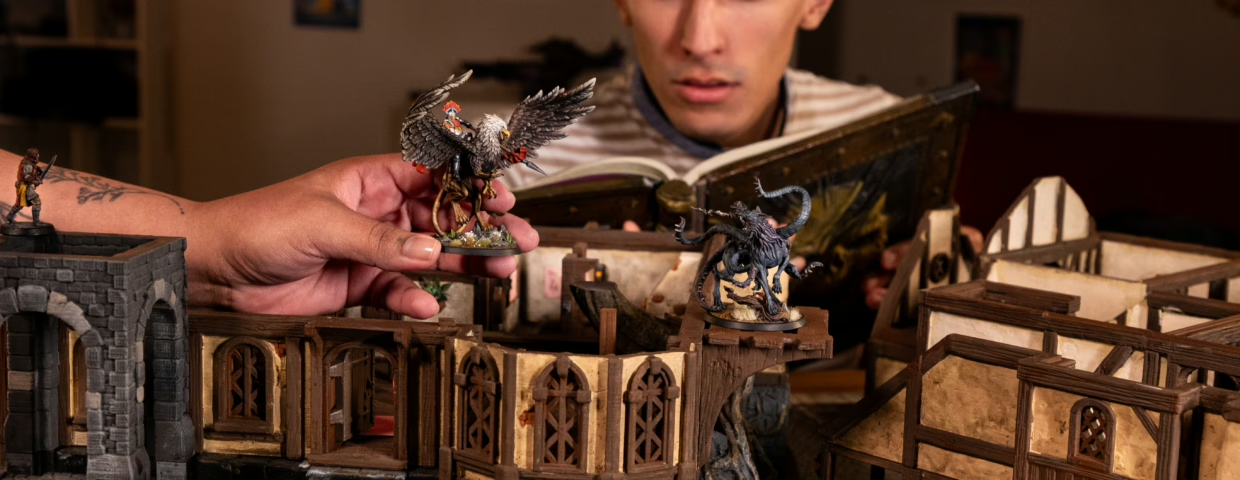
So you’ve decided to jump into the world of tabletop role-playing games. You have the dice, the snacks, and the willingness to embark on an epic adventure. And you need to build a hero. If you don’t know where to start your RPG character creation, don’t worry. You are in the right place.
Whether you are joining a Dungeons & Dragons campaign, a sci-fi horror, or a fantasy epic, the process of breathing life into a fictional persona is the most magical part of the hobby. At Loot Studios, we believe that every great adventure starts with a single, well-crafted hero. We are here to walk you through this journey step-by-step. Let’s roll for initiative.
“I’m not creative enough.”
It’s what I hear 109% of the time that I mention I play RPGs. And what I answer 109% of the time is, “You don’t have to be creative.” It’s totally fine if you start rolling dice to randomly pick backstory traits in the Player’s Handbook. It’s there for a reason, you know?
However, we want to help you step-by-step in your RPG character creation and strip away the confusing jargon to avoid headaches. By the end of this article, you will have a character ready to fight, talk, or sneak their way into glory.

Quick Guide: How to Create an RPG Character
- Start with a simple concept: Describe your character in one sentence. Example: “A disgraced knight seeking redemption” or “A wizard who accidentally burned down their own library.”
- Choose a class that sounds fun: Pick a role that matches how you want to play. Fighter, Rogue, Wizard, Cleric, Druid, or anything that excites you. Don’t worry about optimization.
- Assign your main strengths: Put your highest stats where they matter most for your class. A strong Fighter needs Strength. A persuasive Sorcerer needs Charisma.
- Give them a personality quirk: Add one memorable trait, habit, fear, or mannerism. Small details often make characters more memorable than elaborate backstories.
- Create a short backstory: Answer three questions: Where did they come from? Why are they adventuring? Who or what still matters to them?
- Name your character: Keep it simple and easy to remember. If you’re stuck, use a fantasy name generator for inspiration.
- Define a clear goal: Every great character wants something. Revenge, knowledge, glory, redemption, wealth, or adventure. A clear goal helps drive roleplay and story development.
- Leave room for growth: Your character doesn’t need a complete life story. The most important adventures happen during the campaign, not before it.
- Think like a team player: Give your character a reason to trust and cooperate with the party. RPGs are collaborative stories.
- Bring them to life: Consider using a miniature, artwork, or token to help visualize your hero and strengthen your connection to the character.
Part 1: What You Really Need to Know First
To create an RPG character is to create a part of a fan fiction with your friends. And you are deciding what story you’ll tell together. To think of your character is to think of your role in the group and what your story is.
But before you write a 10-page novel about your hero’s childhood pet, you need a skeleton. An RPG character is made of three core pillars:
- The Concept: Who are they in one sentence? (e.g., “A disgraced knight looking for redemption.”)
- The Mechanics: What can they do? (This is where RPG character classes come in).
- The Personality: How do they act under pressure?
If you remember nothing else, remember this: start simple. Complexity comes from playing the game, not from pre-game homework. Your goal right now is to create an RPG character that is fun to play for 3-4 hours, not necessarily one that wins a literary award.
Part 2: The Pre-Game Checklist (What Do I Need?)
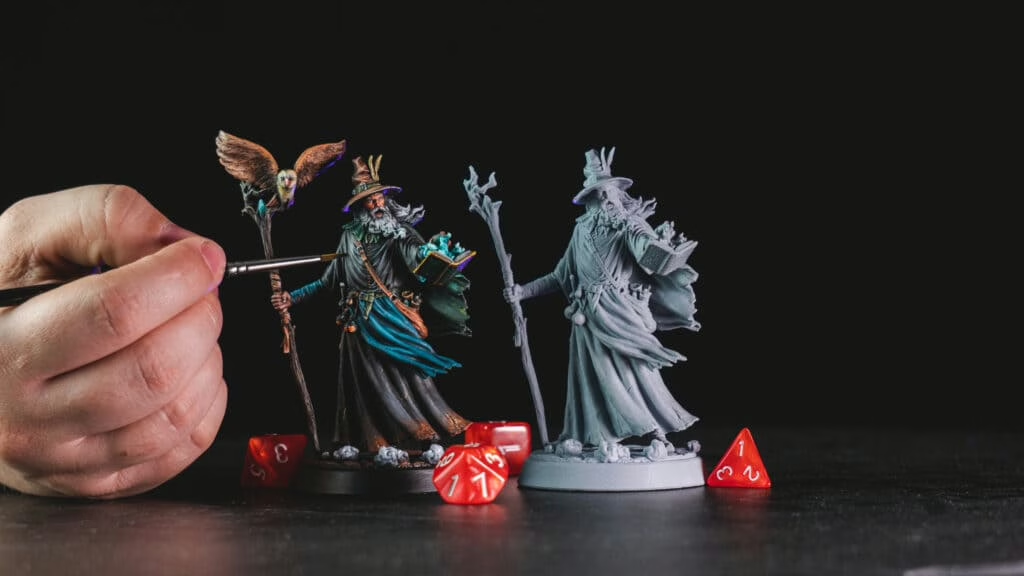
The answer is less than you think. You do not need the $50 rulebook immediately. Here is your minimalist toolkit:
- A Core Rulebook (or a free basic rules PDF): Most systems (like D&D 5e) offer free basic rules online.
- A Character Sheet: You can print this or use a digital, form-fillable PDF.
- Pencils and an Eraser: Trust me, you will change numbers a dozen times.
- Dice (or a digital roller): Usually a 7-dice set, depending on the system.
- Your Imagination: The most powerful tool of all.
Part 3: The Step-by-Step Process (The Right Order)
Most new players freeze because they try to do everything at once. Don’t panic! Here’s what you’ll do:
Step 1: The High-Concept (The “Elevator Pitch”)
Do not open the rulebook yet. Answer this: If your character was in a movie trailer, what would the narrator say?
Example: “A naive wizard who accidentally set his own library on fire.” or: “A quiet rogue who only steals from corrupt nobles to feed orphans.” And yes, it’s ok to get inspiration from other stories, like Robin Hood.
Now, write your trailer sentence down. This is your North Star. When you get lost in numbers later, you return to this sentence.
Step 2: Choose Your RPG Character Classes
This is where the game gets tactile. Your class is your “profession,” your combat style, and your role in your group. Do you want to smash faces? Barbarian or Fighter. Heal friends? Cleric or Druid. Cast spells? Wizard or Sorcerer.
If you are unsure, we have a dedicated guide on the best classes for support characters that breaks down how to keep your party alive. For a beginner, Fighter (simple and durable) or Rogue (skillful and tricky) are excellent first choices. Don’t worry about “optimal” builds. Worry about what sounds cool.
Step 3: The Ability Scores (The Numbers)
Most systems use six stats: Strength, Dexterity, Constitution, Intelligence, Wisdom, and Charisma.
- Ask yourself: Is my hero strong? Smart? Charismatic?
- The rule of thumb: Put your highest number in the main stat for your RPG character class (e.g., Strength for a Fighter, Charisma for a Sorcerer).
- Think differently: A hero with a low stat (like an ignorant wizard or a weak barbarian) is hilarious and memorable. And it’s ok!
Usually, for D&D and other systems that use those stats, you’re going to roll 4d6 for each stat and remove the smallest number.
Example: I rolled 4, 2, 6, and 3. I disregard number 2 and add the rest. So 13 is the number that I’ll choose in which status it goes.
Step 4: The Personality & Flaws (The Soul)
Now we get to the fun part. And you need a little pizzazz. Do not just write “my hero is brave.” Write a quirk.
- Like a voice: Do they speak very fast? Do they have a lisp? Do they use overly complex words?
- Mannerism: Do they tap their foot when lying? Do they collect stray buttons?
- Fear: What terrifies them? (Heights, spiders, intimacy, failure?).
We also need to look at how to choose traits for an RPG character. Traits are mechanical ribbons that give you bonuses (like being a sailor giving you navigation skills). Pick traits that tell a story. A “criminal” background means you have a contact in the underworld. A “noble” background means people recognize your family name and you can get away with—almost—anything.
Step 5: The Backstory (One Paragraph Only!)
Here is a controversial opinion: Do not write a novel. But I must admit that I have written 11 pages of background for my betrayed fatherless half-elf druid. She was just a girl, you know?
Anyways, your character’s backstory is what happened before the game starts. The game is about what happens next.
A good RPG character backstory answers three questions:
- Where did I come from? (Village, city, another dimension?)
- Why am I adventuring? (Revenge, wanderlust, a lost artifact?)
- Who is waiting for me? (A rival, a lost love, a dead mentor?).
That is it. Leave blanks. Let the Game Master (GM) fill in the gaps. Mystery is a cool tool.
Step 6: The RPG Character Name Generator Moment
Naming is hard. If you are stuck, use an RPG character name generator. There are dozens online. You can mix and match syllables. Or steal from history (e.g., “Leonidas” for a proud warrior). A name doesn’t need to be unique; it needs to be sayable. If your GM stumbles every time they say your name, change it.
Part 4: The Deep Dive – Questions You Must Answer
To flesh out the hero, let’s look at the best RPG character creation questions. You don’t need 100 questions. You need 10 good ones. Answer these, and you will know your character better than the player who wrote a 20-page diary. (Self-critic.)
- What is in their pockets right now? (A lucky coin, a worn letter, a strange key?).
- What is their guilty pleasure? (Expensive wine, bad romance novels, sleeping in mud?).
- How do they react to failure? (Do they cry, get angry, or laugh it off?).
- What is a secret they haven’t told the party? (A crime, a lie, a hidden lineage?).
- Who was their first kill? (If applicable—an animal, a monster, or a person?).
- What do they order at a tavern? (Ale, water, or weird tea?).
- What is their pet peeve? (Loud chewing, bad hygiene, or slow walkers?).
- What would make them betray their best friend? (A million gold? Saving a family member?).
- How do they dress? (Practical leathers, flowing silks, or dirty rags?).
- What is their ultimate goal? (Is it wealth, power, love, or just a quiet farm?)
Your RPG character goals drive the plot. A character who wants “revenge on the dragon” is easy for a GM to write for. A character who wants “to find the meaning of a weird dream” is a mystery box. Make sure your goal is something you can actively pursue in the game.

Part 5: Common Mistakes and How to Avoid Them
Even veterans fall into these traps. Here is your warning list:
- The Lone Wolf: “My character doesn’t trust anyone and works alone.”
Problem: RPGs are a team sport. If you refuse to cooperate, you are boring. Solution: Give your loner ONE reason to trust the party. - The Main Character Syndrome: Expecting the story to revolve only around you.
Problem: Not everything is about you, Karen.
Solution: Share the spotlight. Let people talk. Don’t interrupt other players’ roleplay. If you’re not in the scene, you don’t know what happened. And always ask other players “What does your character think/do?” - The Meme Character: “I am a clown who only honks a horn!”
Problem: Funny for one session, annoying for ten.
Solution: Give your joke character a serious flaw so they have room to grow. - The Min-Maxer: Obsessing over the perfect +5 bonus.
Problem: That’s not how “random” works.
Solution: A failed roll is often more fun than a success. Embrace the chaos.
IF YOU WANT TO IMPROVE YOUR DM SKILLS, WE’VE GOT A GUIDE TO HELP YOU THROUGH THIS PATH!
Part 6: Tools of the Trade (Digital Helpers)
You don’t have to do this alone. Besides our own Loot Studios‘ miniatures for inspiration, use these digital aids:
- Fantasy Name Generators: The king of name lists. If you need a “Dwarven Forgemaster” name, this has it.
- Donjon: Great for random NPCs and quick treasure.
- D&D Beyond (or Pathbuilder): These digital tools walk you through RPG character creation step-by-step, automatically calculating your numbers. They are perfect for absolute beginners.
Remember, how to create an RPG character for beginners is not about mastering the rules. It is about mastering the fun.
Part 7: Advanced Tips – Making Them Memorable
You have the stats and the backstory. Now, let’s talk about performance.
What makes a good RPG character backstory is not the events but the emotional wounds. A character whose parents died is cliché. A character whose parents are still alive and disappointed in them is interesting.
- Try to have fun: No reason for embarrassment here. Nobody is judging you. Don’t let your stage fright get the best of you and your fun!
- The Twist: Take a stereotype and flip it. A barbarian who is afraid of blood. A wizard who is illiterate (they use verbal components only). A cleric who is an atheist. The latter is incredibly funny, by the way.
- The Voice: You don’t need an accent. Just change your cadence. Speak slower. Speak faster. Use shorter sentences. This is the easiest way to embody the hero.
Part 8: When You Are Ready to Play
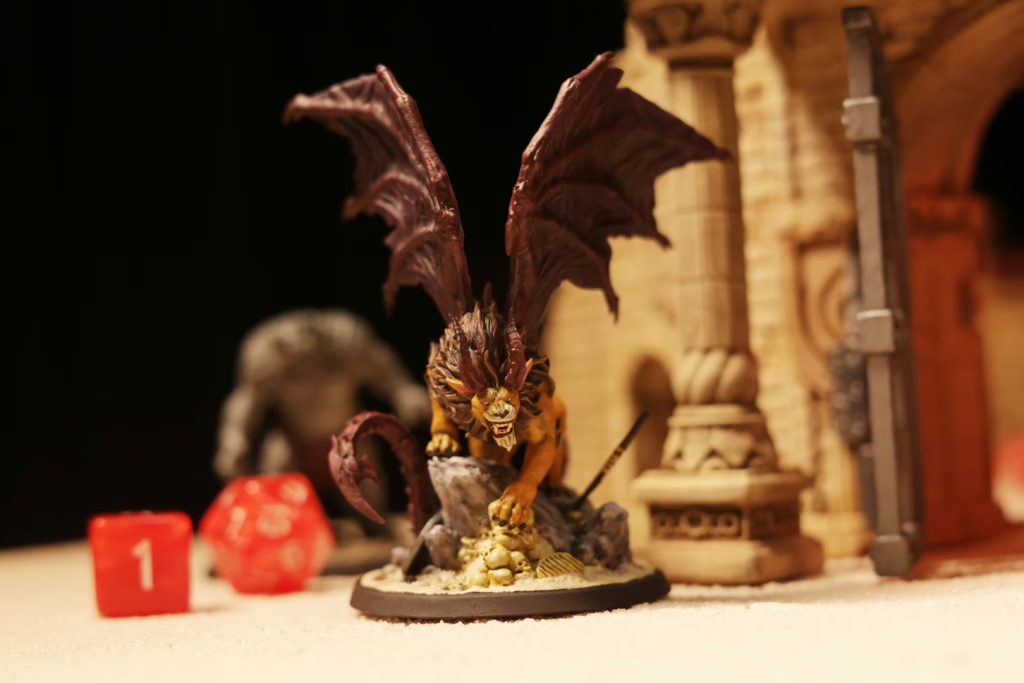
Once your sheet is filled and your personality is set, you need the final piece: the miniature. There is a profound psychological shift when you place a painted mini on the table. You stop being “Dave from accounting” and become “Thorgar the Mighty.”
We recommend checking our guide on Should You Buy or 3D Print Miniatures? to decide what fits your budget. For most beginners, buying pre-printed or unpainted minis from a local store is the easiest path. Seeing the physical representation of your RPG character locks in your commitment to the role.
Part 9: The GM’s Perspective (Understanding Your Dungeon Master)
If you want to be a favorite player, create a character that helps the GM tell the story.
- Give Hooks: In your backstory, leave three open threads (a lost sibling, a cursed item, a bounty hunter after you).
- Be Proactive: Don’t wait for the GM to drag you into the dungeon. Push the red button. Open the weird door. Your goal is to engage with the world.
If you are also curious about running the game, we have an excellent resource: How to Play DnD: The Complete Beginner’s Guide to Tabletop RPGs.
Part 10: Expanding Your Library
As you grow from a beginner to an intermediate player, you will want more depth. We suggest reading 7 Books for Dungeon Masters and Players. While aimed at GMs, these books teach narrative structure, world-building, and character psychology that will make your RPG character creation infinitely better.
Conclusion: Your Journey Starts Now
You have made it through the guide. You no longer need to ask how to create an RPG character for beginners because you are the beginner who now knows the path. Beautiful, right? The process is simple: Concept, Class, Numbers, Personality, Backstory, Name. And remember to have fun!
Loot Studios can help you tell your story through highly detailed minis, statues, terrains, busts, and props. Sign up for Loot and choose your favorite bundles from our library of more than 130 options. You can also learn more about our printing and painting process by checking our YouTube Channel.

Luiza Romagnoli is an autistic Brazilian woman, journalist, and obsessed with RPG. She has been writing since she can remember, but it was in 2017, posting texts on Instagram, that she began to take it seriously. She has a poetry book published by Patuá Publishing House: sirva o chá. Nowadays, Luiza is a multi-hyphenned professional: she’s a writer, translator, English and Spanish Teacher, and has an RPG stationery store: Papelaria do Aurel. Although having all these jobs almost leave no room for her D&D sessions, she still loves them.