How to Fix Your RPG Campaign: From Shallow to Immersive Gameplay
You have spent hours weaving lore, drawing maps, and building a world you are proud of. Yet, when session day arrives, you feel… a subtle drag in the energy, players checking their phones, and that sinking feeling in your gut that your RPG campaign is falling flat. If you have ever whispered to yourself, “Why isn’t this working?” you are not alone. The difference between a forgettable session and a legendary one often comes down to a few specific, actionable pillars of immersive gameplay.
Most Dungeon Masters (especially beginners) suffer from the same pain point: they believe their stories are weak. Usually, the narrative is fine; it is the delivery that lacks structure.
In this guide, we will dissect how to create immersive RPG campaign gameplay structures using professional pacing, deep NPC dynamics, and consequence systems. More importantly, we will show you why miniatures improve immersive gameplay in RPGs is not just a luxury—it is the secret ingredient to keeping players engaged. Let’s fix your table.
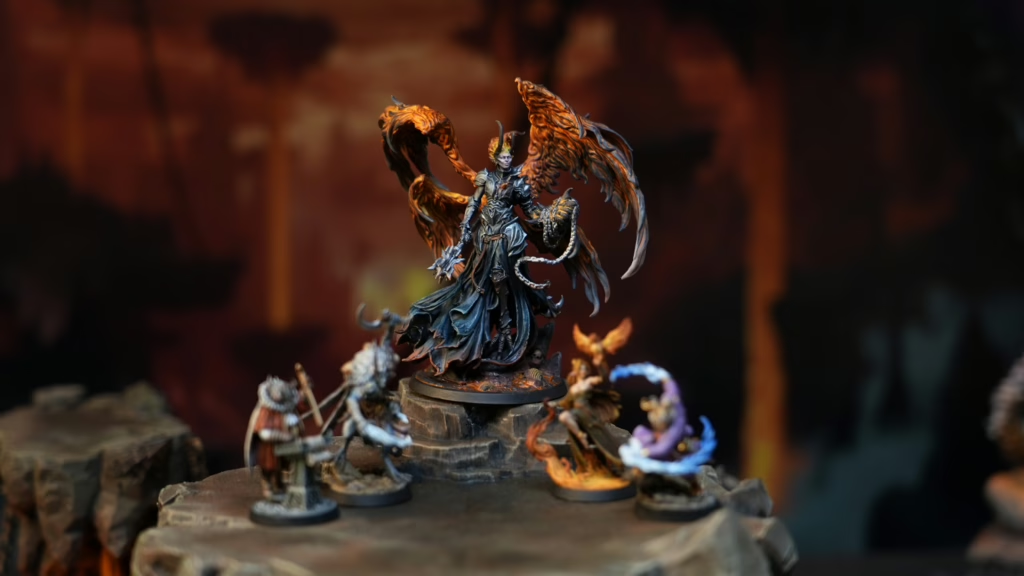
Why Your RPG Campaign Lacks Urgency
Before we dive into tools and techniques, let us look at the classic “inverted pyramid” of session design. If your RPG gameplay feels slow, you are likely starting with exposition (a history lesson) instead of action. To achieve immersive gameplay, you can try starting in medias res—in the middle of the action.
Think of the opening of The Dark Knight. It does not start with Bruce Wayne waking up. It starts with a bank heist. For your RPG campaign, drop your players into a tense negotiation, a collapsing bridge, or the aftermath of an explosion. You can backfill the lore later. This immediate tension signals to the brain that this is important, forcing players to lean in and pay attention.

1. Mastering Pace: The Heartbeat of Immersive Gameplay
Pace is the rhythm of tension and release. A common mistake in a failing RPG campaign is keeping the throttle at 100% (leading to exhaustion) or 0% (leading to boredom). Great RPG gameplay breathes.
The 20-Minute Rule
Neuroscience suggests that the average adult attention span for passive listening is about 20 minutes. In an active RPG campaign, you have even less time before mental drift sets in. Every 20 minutes, you need a “hook reset.”
- The Lull (2-5 minutes): Shopping, planning, or traveling. Use this time for character interaction.
- The Tension (5-10 minutes): A skill challenge, a trap, or a mysterious discovery.
- The Spike (5-10 minutes): Combat or high-stakes social conflict.
How to fix slow pacing:
If your players are arguing about which door to open for 15 minutes, introduce a consequence. Roll a random encounter die audibly. Let the torches flicker out. Time does not stop in an immersive gameplay world.
Look at Breaking Bad. Vince Gilligan mastered the “slow burn” followed by the “explosion.” Your RPG campaign can have those cold opens and cold closes.
Let’s get more visual!
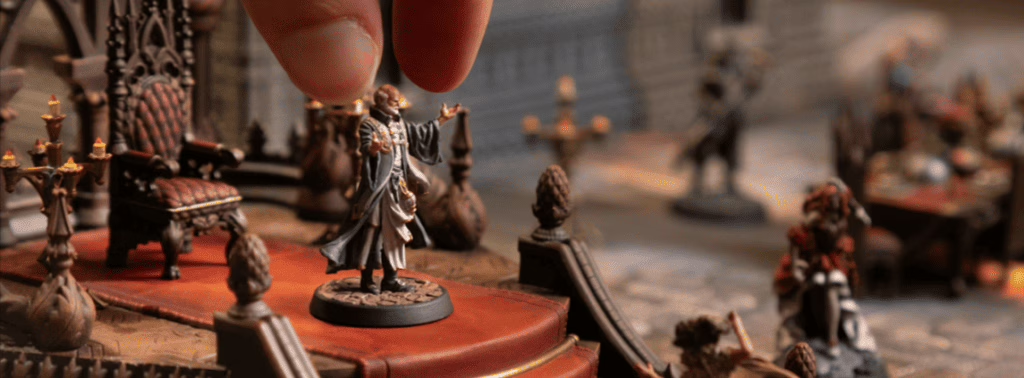
Example Session:
Context: The party has entered a swamp to find a lost healer. They have been walking for hours (in the previous session). This is the opening of Session #4.
Minute 0-2: The Hook Reset (Start In Medias Res)
Instead of saying “You continue walking,” the DM starts hard:
DM: “Roll a Perception check. … Okay, Rogue, you notice the bubbles in the murky water to your left have stopped moving. Everything is silent. No birds. No insects. Then you see it—a pair of glowing yellow eyes, two feet above the waterline, staring directly at the Cleric. What do you do?”
- Why this works: The brain immediately wakes up. Threat detected. No time for phone checking.
Minute 2-7: The Spike (Combat / High-Stakes Action) – 5 minutes
DM: “The creature lunges! It’s a gigantic crocodile with moss growing on its back like a throne. Roll for initiative.”
- Round 1: Fighter charges and slashes. Crocodile grabs the Fighter in its jaws (Grappled condition).
- Round 2: Cleric heals. Rogue stabs from behind. Wizard casts Magic Missile.
- Round 3: Crocodile, bloodied, retreats into the water. Combat ends.
Result: Adrenaline spike. Players are now fully engaged. They used resources (spell slots, health). They won, but barely.
Key Insight: The spike does not need to be lethal. It just needs to be urgent. 5 minutes of combat is enough to reset attention spans.
Minute 7-12: The Lull (Recovery & Character Interaction) – 5 minutes
The combat is over. The crocodile is gone. Now the players breathe.
DM: “The water is still again. The crocodile left a trail of blood leading deeper into the swamp. You see the healer’s satchel—a blue bag with a white flower—floating near a twisted tree root. What do you do?”
Player (Rogue): “I grab the satchel. Is there anything inside?”
DM: “A half-empty potion bottle, a handwritten letter, and a small toy horse. The letter says, “Mom, I went to find the cure. Don’t follow.'”
Player (Cleric): “I cast Detect Magic on the tree root.”
DM: “No magic. But you notice the roots are wrapped around a stone door, half-sunken in the mud.”
Player (Fighter): “I want to carve a notch into my sword handle to mark this spot. One notch for each beast we kill.”
- Why this works: This is roleplaying time. No dice rolls (or very few). The players are bonding, looting, and planning. The lull feels earned because they just survived trauma. Their brains are relaxed but still listening.
Warning: Do not let the lull exceed 5-6 minutes. If they start debating which flavor of ale to buy, interrupt with The Tension.
And so on and so forth.
Of course, this is just an example, and you can adapt it to your DM style. Getting to know how your players engage in the situation and what it is that they like doing the most (roleplay or combat) helps, but this is something you’ll notice with time as your campaign goes on.
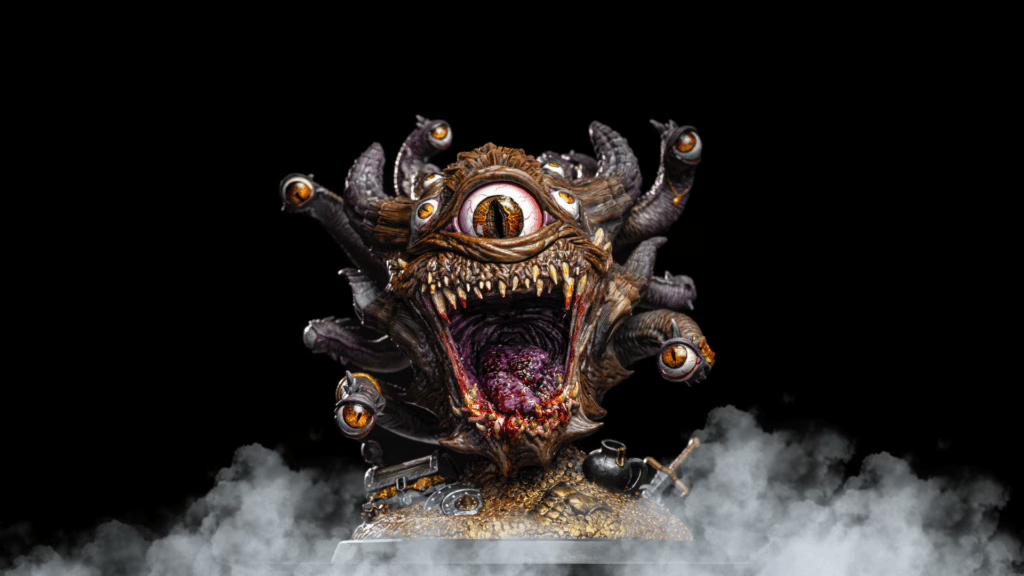
2. Narrative Depth: Beyond the Railroad
Many DMs confuse a linear plot with a weak narrative. A linear plot is fine; a railroad (where player choices don’t matter) is not. To create memorable RPG campaign moments, you need to build situations, not plots.
The “Yes, And…” Philosophy
Improvisation is the soul of RPG gameplay. When a player asks if there is a chandelier to swing on, say “yes” (even if you didn’t plan it). This turns your RPG campaign into a collaborative story.
How to create memorable RPG campaign moments:
- The Reincorporation: Bring back a minor detail from session 1 in session 10. That random goblin they let live? He is now the king’s advisor.
- The Set-Piece: Design one visual, tactile moment per session. A collapsing tower. A chase through a market. This is where miniatures’ role in improving immersive gameplay in RPGs becomes vital (more on that soon).
Cultural Reference: In The Legend of Vox Machina, the most emotional moments are not the big fights; they are the quiet moments in a tavern where Grog drinks milk. Balance your epic fantasy with human (or elf) moments.
3. NPC Dynamics: Making the World Breathe
Flat NPCs are the number one killer of immersive gameplay. If every shopkeeper sounds like a video game vendor (“Khajiit has wares if you have coin”), your RPG campaign feels fake.
The Three-Face Rule
For every major NPC, define three things instantly:
- What they want (Goal).
- What they fear (Flaw).
- A vocal tic or physical habit (The “pizzazz”).
Dynamic Interaction
NPCs can react to the party’s reputation. If the players saved a village, the next town should welcome them with a parade. If they murdered a guard, bounty hunters should track them. This is action and consequence.
Deep Relationships
Do not let NPCs be static quest-dispensers. Allow NPCs to betray the party, fall in love with them, or die for them. Nice tools for tracking all of this are Miro, Notion, and Obsidian for mapping out relationship webs, places, items, etc. You can connect NPCs to each other, not just to the players. When the players kill Bandit A, Bandit B (his brother) should seek revenge ten sessions later.
The Witcher 3: Wild Hunt is a masterclass in this. The Baron’s storyline is memorable because his relationship with the player changes based on action and consequence.
4. Action and Consequence: The Ultimate RPG Gameplay Loop
If your RPG campaign feels weak, it is likely because there are no stakes. Players need to know that failure is an option. How to keep players engaged in RPG campaigns is simple: make their choices hurt.
The Quantum Ogre
The old “Quantum Ogre” concept basically says that the ogre is always in front of the players regardless of which path they take. And that is not so interesting. Good consequence means:
- Path A (Forest): They fight the ogre but find a druid grove.
- Path B (Mountains): They avoid the ogre but face a wyvern.
Both are fun, but different. The players must feel their choice changed the outcome.
Creating a Consequence Tracker
Use a simple spreadsheet or a physical journal. Label three columns:
- Player Action
- Immediate Consequence
- Delayed Consequence (3 sessions later)
Example:
| Player Action | Immediate Consequence | Delayed Consequence |
| Spared the Goblin | Goblin gives them a rusty key. | The Goblin becomes a spy for the BBEG. |
| Burned the Warehouse | City guard fines them. | A homeless family starves without supplies. |
When you bring up the delayed consequence later, the players will gasp. That is immersive gameplay.
5. The Visual Revolution: Why Minis Are Not Optional Here
Now, let us address the elephant in the room. There is a common objection among beginner DMs: “Minis are not important for immersive gameplay; I can use theater of the mind.”
Yes. But…
Theater of the mind is beautiful for travel and roleplay. But to create immersive gameplay in tabletop RPGs during combat and exploration, the human brain craves visual anchors. According to the dual-coding theory (Paivio), we remember information better when it is processed visually and verbally.
Why your RPG campaign needs miniatures:
- Tactical Clarity: No more “Where am I?” delays. This speeds up RPG gameplay by 30%.
- Emotional Investment: When a player spends time painting a miniature of their character, they are psychologically committing to the game. They will fight harder to keep that mini alive.
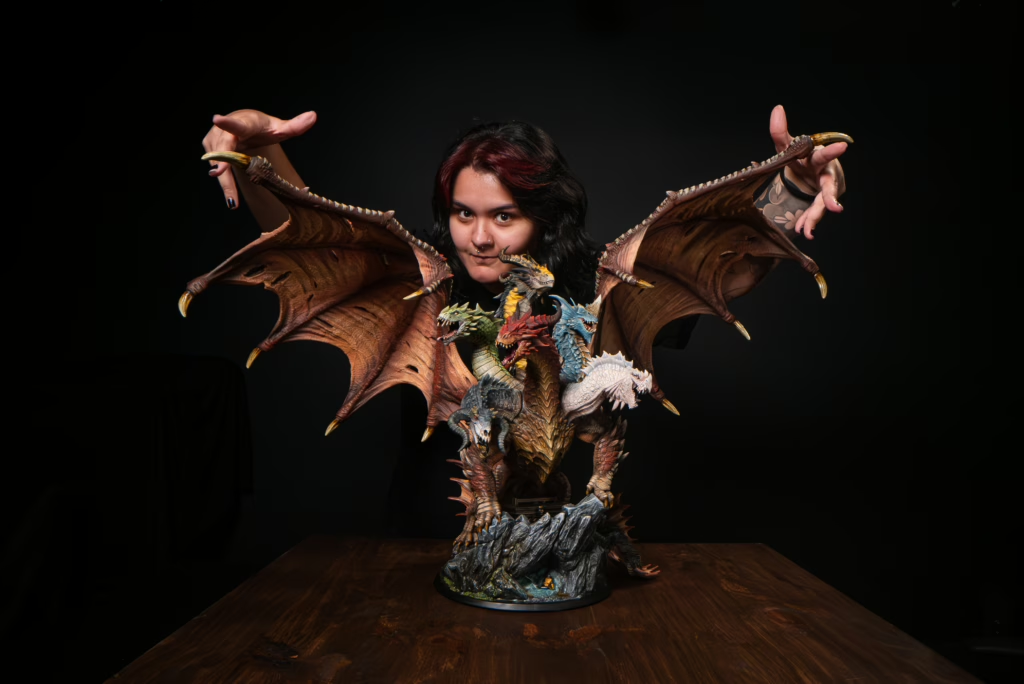
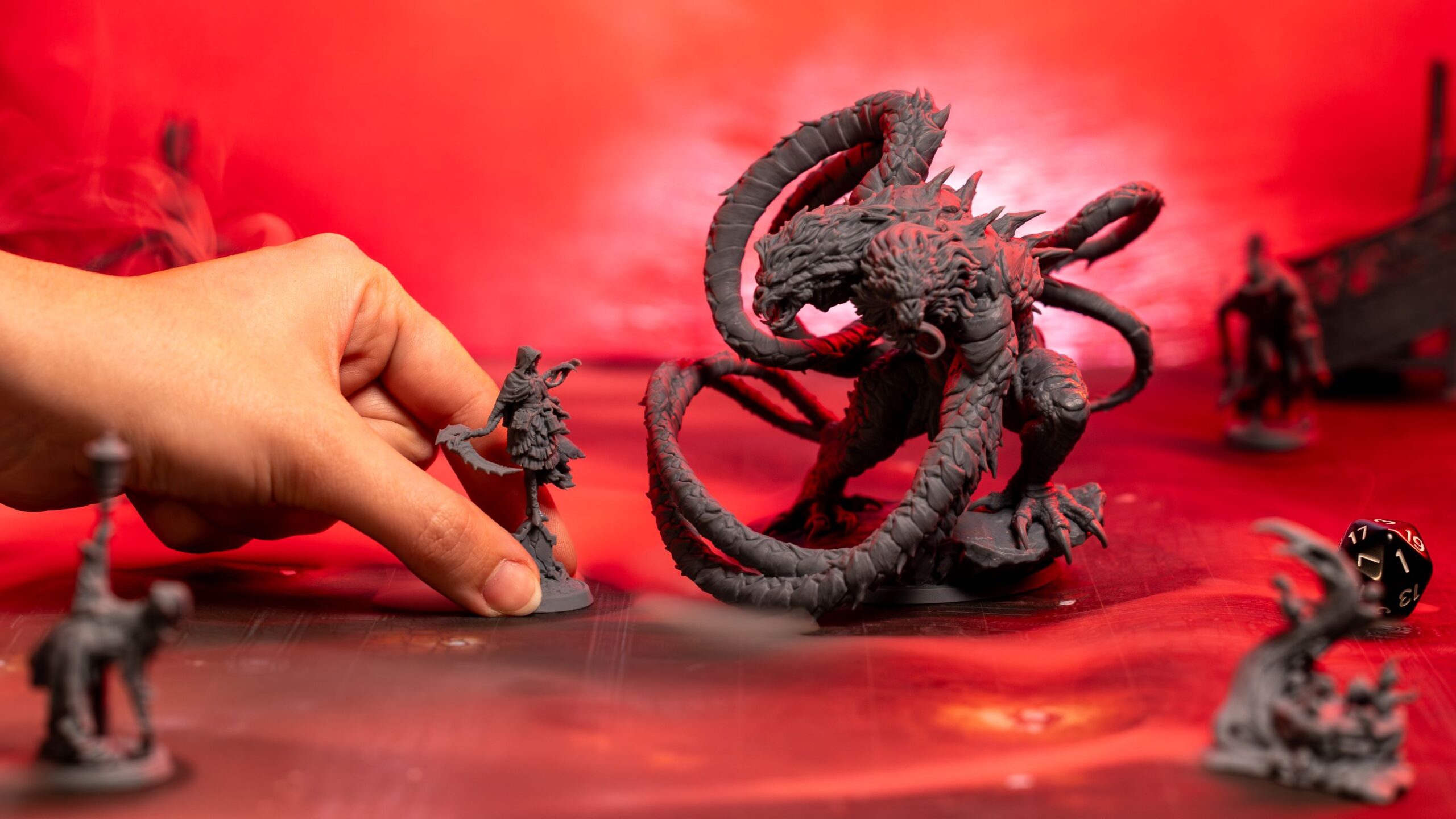
- The “Ooh” Factor: Placing a massive dragon mini on the table changes the energy instantly. It tells the players, “This is serious.”
Detail invites storytelling. A mini with a scar on its face prompts the player to ask, “How did you get that scar?” A detailed Lich mini with runes on its staff tells the players, without the DM narrating or rolling any die, how to kill it (smash the staff).
Bridging the Gap: Buying vs. 3D Printing
You might be thinking, “I agree with the theory, but I cannot afford an army of minis.” This is where we pivot from consumer to creator. How miniatures improve immersive gameplay is undeniable, but how you acquire them changes your freedom.
To understand exactly which method saves you money and gives you more freedom, you should read our detailed comparison: Should You Buy or 3D Print Miniatures? It breaks down the math and the logistics for your specific RPG campaign needs.
By printing, you are not limited to generic monsters. You can print exactly the villain from your head. This is how to create memorable RPG campaign moments—by surprising your players with a monster they have never seen before in plastic.
The Final Step: Making It Tactile
We have covered pace, narrative, NPCs, and consequence. But the glue that holds immersive gameplay together is the tactile feedback loop. When a player moves a 3D printed mini across a physical piece of terrain, their brain registers the event as real.
This is why we exist. Loot Studios designs worlds to help you unleash your stories. You have the imagination; we provide the best miniatures for immersive campaigns.
By printing your own minis, you gain the freedom to print a monster again if you need a second phase of the boss fight. You can scale a mini up to 150% to make a “giant” version. You are the master of your table.
And remember: To keep players engaged in RPG campaigns is not about writing a novel. It is about creating a sandbox where actions have weight, NPCs have souls, and the visuals make the fantasy real. Print the monsters. Build the terrain. Roll the dice.
Your legendary RPG campaign starts now.
Loot Studios can help you tell your story through highly detailed minis, statues, terrains, busts, and props. Sign up for Loot and choose your favorite bundles from our library of more than 130 options. You can also learn more about our printing and painting process by checking our YouTube Channel.

Luiza Romagnoli is an autistic Brazilian woman, journalist, and obsessed with RPG. She has been writing since she can remember, but it was in 2017, posting texts on Instagram, that she began to take it seriously. She has a poetry book published by Patuá Publishing House: sirva o chá. Nowadays, Luiza is a multi-hyphenned professional: she’s a writer, translator, English and Spanish Teacher, and has an RPG stationery store: Papelaria do Aurel. Although having all these jobs almost leave no room for her D&D sessions, she still loves them.